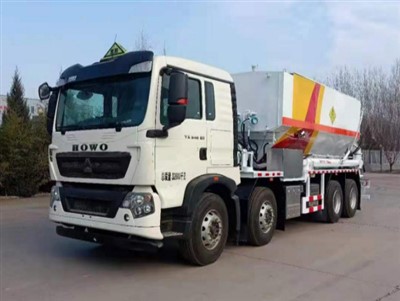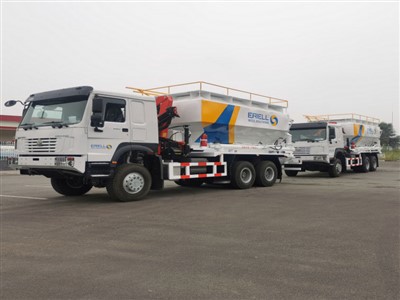
The design of hybrid explosives transport vehicles is far more than a simple modification of ordinary special-purpose vehicles; it is a systems engineering project centered around three core objectives: "inherent safety, efficient operation, and full-process control." Its design concept profoundly reflects the philosophy and methods that modern industry must follow when "moving" high-risk activities from fixed factory buildings to mobile platforms, representing a high degree of integration between technological rationality and the principle of safety first.
Fundamental Concept: Inherent Safety and Risk Reconstruction
This is the starting point and highest principle for all design decisions. The risks of traditional models are concentrated in the transportation and storage of finished explosives. The core concept of hybrid transport vehicles is to reconstruct the risk distribution, that is, to eliminate or reduce the highest level of risk at the source through changes in technological pathways. This is specifically manifested in:
1. Insensitive Design: Inherent safety of transported materials. The vehicle design revolves around transporting insensitive semi-finished products such as "detonator-free latex matrix." These materials, under normal conditions (item 1.4S), have a much lower sensitivity than finished explosives (item 1.1), thus significantly reducing the risk level during the most uncontrollable stage of long-distance transport.
2. Process Minimization and Immediacy: The design minimizes the duration and space required for the most dangerous form of "finished explosives." Sensitization and mixing are completed within a controlled onboard system only at the blasting site, just before loading into the blast hole, and the material is used immediately. This achieves "zero inventory" (during transportation and storage) and "produced and consumed immediately" for high-risk materials.
Core Functional Concept: Integrated and Precise Operation The vehicle is designed as a "mobile miniature chemical plant and construction machinery," with a revolutionary concept of functional integration.
1. High Integration of Functional Modules: Within the limited vehicle space, a raw material silo (tank), power system, precision metering system, dynamic mixing system, conveying and loading system, and intelligent control system are integrated. This requires the design to address the high degree of coordination among subsystems in terms of spatial layout, weight distribution, power matching, vibration, and thermal management.
2. The Ultimate Pursuit of Precision and Reliability: As a production terminal, its metering and mixing system must achieve the precision level of a fixed production line. The design employs high-precision metering pumps, mass flow meters, automated valve assemblies, and a disturbance-resistant control system to ensure precise control of formulation ratios and charge quantities even in bumpy, temperature-varying outdoor environments. This is its value in replacing the functions of a fixed production line.
III. Process Control Concept: State Awareness and Intelligent Management
The design concept emphasizes "all-time, all-domain, knowable, and controllable" status of the vehicle itself and the operational process.
1. Multiple Active Safety Designs: Beyond passive protection, integrating active safety. This includes: intrinsically safe electrical systems (explosion-proof, spark-proof), chassis stability control, driving speed limits and recording, real-time monitoring of key process parameters (temperature, pressure, flow) and over-limit interlock shutdown. This forms a closed-loop safety control network from driving to operation.
2. Data-Driven and Traceable: The vehicle itself is a data generator and acquisition terminal. The design integrates modules for satellite positioning, automatic recording of operational data (formula, charge quantity, location), and video monitoring. All data is traceable, ensuring transparency in the operational process and providing an immutable digital evidence chain for safety supervision and quality traceability, achieving "mobile equipment, fixed supervision."
Environmental Adaptability and Ergonomics: The design must fully consider extremely harsh field conditions.
1. High Passability and Environmental Tolerance: Utilizing a high-performance off-road chassis, it possesses powerful performance, excellent passability, and reliability to adapt to complex road conditions such as mines and hydropower construction sites. Structural components, hydraulic systems, and electrical components must be dustproof, waterproof, resistant to high and low temperatures, and vibration-resistant.
2. Human-Machine Interaction and Protection: The operating interface is clearly designed with concise logic and includes access control. Maintenance points are easily accessible, and the need for rapid personnel evacuation in emergencies is fully considered. The design of the cab and work area must conform to ergonomics, reducing operator fatigue while providing necessary physical protection for the operator.
In summary, the design concept of the hybrid explosives transport vehicle is a multi-layered system of thought that prioritizes inherent safety, utilizes functional integration, ensures intelligent control, and supports environmental adaptability. Through ingenious system design, it unifies the three contradictions of "the danger of chemical reactions," "the uncertainty of mobile working conditions," and "the precision of operational requirements" within a reliable mobile platform. It represents an outstanding engineering solution to the challenging problem of "transferring the safety standards and process control of fixed factories to mobile scenarios."