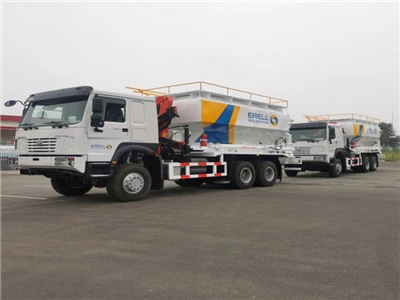
The logistics nature of hybrid explosives transport vehicles (on-site mixed loading vehicles) completely overturns the traditional linear model of "production-warehousing-transportation-use" for hazardous materials, creating a new supply chain model of "proactive production, precise distribution, and immediate consumption." The core of its logistics system lies in the high-level integration of "the flow of goods" and "value creation" in time and space, thereby achieving a qualitative leap in safety, efficiency, and control.
I. A Fundamental Shift in Logistics Attributes: From "Finished Product Distribution" to "Raw Material Supply + Mobile Production"
In the traditional model, the object of logistics is finished explosives (1.1 dangerous goods) that have already achieved their final explosive properties; their transportation and storage are purely risk- and costly processes. The mixed loading vehicle model transforms the object of logistics into relatively inert semi-finished raw materials (such as latex matrix and porous granular ammonium nitrate, typically 1.4S or 5.1). This means that the logistics process carries "production materials" rather than "final products," fundamentally eliminating the highest-risk "finished product" form and its related warehousing and transshipment links from the logistics chain. The nature of logistics has shifted from "spatial transfer of high-risk finished products" to "supply of safe raw materials and a carrier for mobile production."
II. Restructuring of Logistics Processes: Integration, Just-in-Time (JIT), and Closed-Loop Operations
Its logistics processes exhibit highly integrated and precise characteristics:
1. Integrated Process: It integrates three major functions: "transportation," "online mixing," and "loading," achieving a direct "door-to-hole" service from raw material delivery to final use, greatly simplifying the multi-stage, multi-entity handover and warehousing processes of the traditional model.
2. Just-in-Time (JIT) Production: Its operating mode is a typical example of the ultimate application of the JIT production concept in the engineering field. The delivery of raw materials and "production" (mixing) are strictly triggered at precise times and locations based on the specific needs of the blasting site (hole location, hole depth, rock properties), achieving "zero-inventory" blasting and eliminating the risk of large-scale, long-term storage of finished explosives at the construction site.
3. Strong Coupling of Information Flow and Physical Flow: The onboard intelligent system records and uploads real-time data on the entire process, including driving trajectory, raw material consumption, loading coordinates, and operation time. This ensures complete synchronization and traceability of the flow of physical materials and information, forming a digital closed loop from the ground station to individual blast holes. The logistics process simultaneously becomes a data collection and monitoring process.
III. Optimization of Logistics Network and Nodes
This model profoundly impacts the network structure of the entire civil explosives supply chain:
• Specialized Node Functions: Upstream "ground preparation stations" focus on the safe and efficient production of standardized semi-finished products, becoming stable raw material supply centers. Downstream "blasting operation faces" become the endpoint of immediate production and consumption points. The importance of traditional midstream "regional finished product warehouses" and "on-site explosives depots" has significantly decreased or even been eliminated, resulting in a flatter network.
• Dynamic Transportation Routes: As mobile production units, the mixed-load vehicles' travel routes and operational scheduling must be closely linked to the progress of the blasting project. Route planning is more dynamic and task-oriented, rather than fixed point-to-point transportation.
IV. Upgrading Logistics Management: From "Managing Goods" to "Managing Processes + Managing Data"
This places higher demands on logistics management, pushing it to evolve from traditional warehousing and transportation management to comprehensive control of "mobile, real-time production processes." The management focus shifts from ensuring "goods are not lost or damaged" to ensuring "continuous and stable raw material supply, reliable operation of onboard systems, precise control of the mixing process, and complete and accurate data recording." The focus of safety management also shifts from preventing external risks during transportation to ensuring the safety and operational standardization of the onboard production system itself.
Therefore, the logistics nature of mixed explosives transport vehicles represents an advanced supply chain model that compresses the supply chain, overlaps production and consumption in time and space, and transforms risky links into value-creating links. It is not merely an innovation in transportation tools, but a systematic and revolutionary reconstruction of the logistics system for high-risk goods through technological integration. Its core value lies in achieving a unity of safety, efficiency, and controllability through process reengineering, serving as a key logistics foundation for the civil explosives industry's move towards intelligent and service-oriented development.