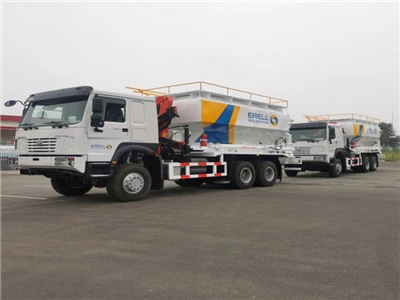
In the entire chain of "production-transportation-use" of civilian explosives, hybrid explosives transport vehicles (often called "on-site mixing explosives vehicles") play a unique and crucial role.It is not simply a cargo handling tool, but a mobile miniature factory integrating raw material storage, online mixing, and precise loading functions; moreover, it is a mobile safety fortress incorporating cutting-edge engineering technology. Its core value lies in transferring the most risky "final synthesis" process of explosives from fixed factory buildings to strictly controlled specialized vehicles, completing it on-site during blasting operations, thereby improving efficiency while systematically reconstructing safety boundaries.
Core Function: A Revolution from "Transporting Finished Products" to "On-site Synthesis"
Unlike traditional vehicles that transport finished explosives, hybrid explosives transport vehicles represent a fundamental change in operating modes. They typically load relatively safe semi-finished raw materials such as detonator-insensitive latex matrix, sensitizers, and fuel oil into separate compartments. Upon arrival at the blasting site, under the control of the onboard computer, the components are precisely metered and uniformly mixed in a dynamic mixer according to a preset formula, and then directly pumped into the blast hole through an extended delivery hose. This integrated process of "raw material transportation, on-site mixing, and on-site loading" completely eliminates the significant risks associated with long-distance transportation and transshipment storage of finished explosives, and achieves mechanization, precision, and intelligence in blasting loading.
The Essence of Safety Design: Integration of a Multi-Layer Defense System
As a carrier of highly hazardous materials, its safety design is a model of special vehicle engineering, constructing a multi-layered system from inherent safety to active protection:
1. Inherent Safety Design: The transported raw materials (such as latex matrix) themselves do not possess detonator sensitivity and belong to Class 1.4 hazardous materials, reducing the possibility of accidental detonation from the source.
2. Structural and Protective Safety: The vehicle chassis and superstructure must meet strict stability requirements (e.g., a fully loaded tilt stability angle ≥23°). The engine exhaust pipe is front-mounted and equipped with a spark arrester to prevent hot surfaces or sparks from igniting the materials. The cargo box or tank body is made of corrosion-resistant materials, with an internal conductive rubber sheet and at least two conductive drag strips to ensure timely discharge of static charge (the resistance between any two points is typically required to be ≤5Ω). Anti-collision guardrails are installed in critical areas to prevent accidental collisions.
3. Active Safety and Intelligent Control: According to the latest national standard GB 21668-2025, medium and heavy-duty vehicles are required to be equipped with Electronic Stability Control (ESC), Lane Departure Warning System (LDWS), and Automatic Emergency Braking System (AEBS). Vehicles must be equipped with speed limiters, with a maximum speed not exceeding 80 km/h. Simultaneously, the entire vehicle is equipped with satellite positioning and a driving recorder for full-process monitoring. The pharmaceutical system itself has automatic alarm and shutdown functions for over-temperature, over-pressure, and material shortage, achieving closed-loop control.
4. Operational Management Standards: From vehicle access (complying with standards such as GB 20300), regular inspections, to daily maintenance ("one vehicle, one file"), strict institutional constraints are established. Dedicated personnel are required during transport, and operations must avoid densely populated areas; operations are suspended during inclement weather. III. Standard Evolution and Specialization The design, manufacture, and operation of this type of vehicle are subject to a series of mandatory national standards. The earlier GB 25527-2010 "Safety Requirements for Mine Mixed Explosives Transport Vehicles" made specific provisions for it. GB 20300-2018, on the other hand, proposed general technical requirements for road transport vehicles carrying explosives. The latest GB 21668-2025 "Safety Technical Conditions for Dangerous Goods Transport Vehicles" integrates and improves multiple standards, further strengthening active safety technologies and structural safety requirements, marking a new stage of more intelligent and refined safety management.
In summary, mixed explosives transport vehicles are core equipment for modern engineering blasting technology towards safety, efficiency, and precision. Through ingenious system design, it confines high-risk chemical reaction processes within a mobile, multi-protected dedicated space, perfectly embodying the modern industrial safety philosophy of "transforming uncontrollable risks into controllable processes through technological innovation and management enhancement." It is not only a powerful tool for mining and infrastructure projects, but also a microcosm of China's technological progress and rigorous standards in the field of civilian explosives safety management.