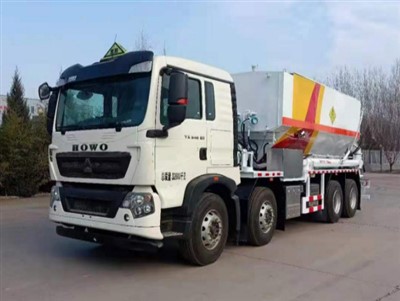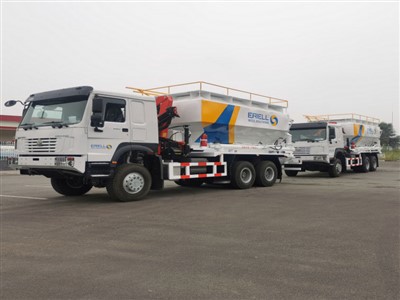
Hybrid explosives transport vehicles are not simply "transportation tools," but rather "mobile risk management systems" integrating passive protection, status monitoring, behavior management, and emergency response. The core of their working principle lies in constructing a dynamically stable safety environment through multiple technologies and management methods, ensuring that high-risk explosives remain in a state of "controlled inertia" throughout the transportation process.
I. Structural Protection Principle: The Physical Foundation of Passive Safety
The system's working principle begins with the vehicle's physical design, with passive safety protection at its core. The multi-layered composite structure of the cargo box (high-strength outer skin, energy-absorbing buffer layer, and anti-static inner lining) constitutes the first line of defense. Its working principle is not "absolute resistance," but rather "controlled dissipation and isolation of energy": when encountering an external impact, the deformation of the outer materials and the controlled collapse of the middle layers absorb and disperse the impact energy, preventing it from being transmitted to the internal cargo. Meanwhile, excellent airtightness and fireproof isolation effectively isolate external fire sources, high temperatures, and potentially leaking small flammable materials, physically cutting off the propagation path of an accident chain.
II. Dynamic Stability Principle: Maintaining System Balance
The core working principle during transportation is maintaining system dynamic stability. This includes:
1. Mechanical Stability: Through scientific loading and securing (using anti-displacement padding and straps) and extremely smooth driver operation (avoiding sudden acceleration, deceleration, and sharp turns), ensuring that goods do not shift, rub, or collide while the vehicle is in motion, eliminating the possibility of accidents caused by mechanical stimulation.
2. Energy Stability: The vehicle's conductive drag strip, anti-static tires, and cargo box lining constitute a continuous static electricity discharge path, ensuring that static charges generated during transportation are conducted to the ground in real time, preventing the accumulation and discharge of static charges from becoming an ignition source. The ventilation system (if activated) gently regulates the internal environment of the cargo box to prevent heat accumulation.
III. Status Monitoring and Feedback Principle: Real-time Perception and Early Warning
The system achieves closed-loop monitoring through "human-machine collaboration." Onboard temperature, humidity, and vibration sensors monitor the microenvironment inside the cargo box in real time; satellite positioning and a driving recorder monitor the vehicle's position, speed, and driving behavior. This data forms a real-time feedback loop: on the one hand, it prompts the driver to adjust operations immediately (e.g., drive smoothly); on the other hand, it provides remote early warning information to the back-end monitoring center. The driver's periodic manual checks (touching, observation) are an important supplement to the sensor network, enabling cross-verification of the system's status.
IV. Program Control Principle: Mandatory Execution of Preset Behaviors
One of the core working principles of this system is the use of strict standardized procedures to constrain all aspects. From qualification review, route approval, and compatibility loading checks, to scheduled checks en route, designated parking, and post-trip recording and archiving, every step is pre-set and mandatory. Its working principle is similar to the "sequential execution" and "conditional judgment" of a computer program; only when the output of the previous step (e.g., pre-departure inspection is passed) meets the conditions can the next step (permission to depart) be triggered. This minimizes the risks caused by human arbitrariness and negligence.
V. Emergency Backup Principle: Worst-Case Pre-set Management
Even in the event of an extremely low-probability event, the system operates according to pre-set principles. The explosion relief device (if equipped) is designed to release pressure and flames in a controlled manner through the directional rupture of specific weak points (explosion relief plates) when internal pressure exceeds limits, sacrificing a local area to preserve the overall system and preventing the entire cargo box from exploding and causing greater damage. Simultaneously, a comprehensive emergency plan, onboard emergency equipment, and a linkage mechanism with external rescue forces constitute the final line of defense.
In summary, the working principle of the hybrid explosives transport vehicle is a comprehensive application integrating materials mechanics, engineering control, information feedback, and organizational management. It operates on the synergistic principles of "multiple protections, dynamic stability, real-time monitoring, procedural enforcement, and emergency backup," constraining unpredictable risks within a predictable and manageable closed system, ultimately achieving the core objective of safe displacement.