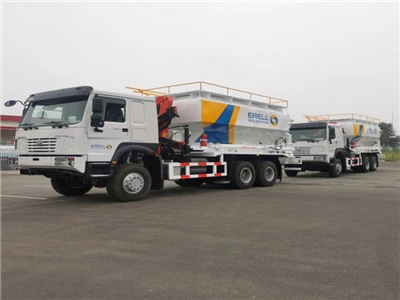
Quality control of hybrid explosives transport vehicles (on-site mixing vehicles) is a rigorous system that spans the entire chain from raw materials to equipment, processes, and products. Its objectives are dual: ensuring the precise and reliable explosive performance of the final explosive charge, and ensuring absolute safety throughout the entire process from transportation and manufacturing to loading. This requires quality control to go beyond traditional product inspection and upgrade to a systematic guarantee for mobile, continuous production processes.
Raw Material Quality Control: The Cornerstone of Safety and Stability The first line of defense in quality control begins at the ground preparation station. Semi-finished raw materials (such as latex matrix, porous granular ammonium nitrate, fuel oil, etc.) provided to the mixing vehicle must meet strict internal control standards, as their stability directly affects transportation safety and on-site mixing quality. Key control points include:
1. Formulation and Performance Stability: The formulation of the latex matrix (oxidant concentration, oil phase material ratio) must be rigorously designed and validated to ensure its chemical and physical stability during storage, preventing demulsification, crystallization, or performance degradation.
2. Key Physical Properties: The viscosity, density, water resistance, and sensitization characteristics of the matrix are regularly tested to ensure they meet the process requirements for pumping, mixing, and subsequent sensitization. The particle size and oil absorption rate of ammonium nitrate, and the flash point and viscosity of fuel oil, must also meet regulations.
3. Storage and Transfer Management: Temperature control, contamination prevention, and regular circulation of raw materials in storage tanks are crucial to ensure consistent batch quality of raw materials delivered to the mixing truck.
Quality Control of Onboard Systems: Guarantee of Reliable Operation As a mobile production platform, the condition of the vehicle's own equipment is a key aspect of quality control:
1. Accuracy and Calibration of the Metering System: This is the core of quality control. High-precision metering pumps, flow meters, and densitometers used to transport components such as the aqueous phase, oil phase, and sensitizer must be calibrated regularly (usually per shift or daily) to ensure that the proportioning accuracy error is within a very small range (typically better than ±1%). Any metering deviation will directly lead to fluctuations in the performance of the final product.
2. Efficiency of the Mixing System: The shear efficiency and mixing uniformity of the dynamic emulsifier or mixer need to be regularly assessed and maintained to ensure a uniform output matrix.
3. Reliability of the Safety and Control System: The functions of temperature and pressure sensors, interlocking protection devices, and emergency shutdown systems must be periodically tested and verified to ensure accurate and reliable response.
Quality Control of the On-Site Mixing Process: Dynamic and Precise Implementation
At the blasting site, quality control is manifested in the real-time monitoring and adjustment of the "mobile production" process:
1. Real-time Monitoring of Process Parameters: Operators monitor key process parameters such as flow rate, pressure, temperature, and mixer speed of each component in real time on the control panel to ensure operation within the preset safety and quality window.
2. Precise Execution of Formula and Charge Quantity: The onboard computer automatically controls the flow rate of each component based on the formula (such as explosive density and detonation velocity requirements) and single-hole charge quantity input in the blasting design. Quality control requires double-checking of input data and real-time comparison and recording of cumulative charge quantities.
3. Rapid On-Site Inspection: Periodically (e.g., at the start of each shift or when the formula changes), samples are taken from the delivery hose outlet for simple density measurements and detonation velocity tests (using specialized instruments) to quickly verify whether the product performance meets design requirements.
Data Traceability and Personnel Training: A Closed-Loop Management System
1. Full-Process Data Recording: The vehicle's intelligent terminal automatically and immutably records the start time, travel trajectory, raw material consumption, process parameters, and loading location and quantity for each operation. This data serves as the primary basis for quality traceability, performance analysis, and safety audits, forming an electronic quality archive.
2. Personnel Qualifications and Standardized Operation: Operation and maintenance personnel must undergo rigorous professional training and assessment, and be certified to work. Their standardized operation and ability to handle abnormal situations are the final link in ensuring the effective implementation of the quality control system. Regular refresher training and emergency drills are essential.
Conclusion: The quality control of mixed explosives transport vehicles is a closed-loop system that deeply integrates source raw material management, equipment status assurance, process parameter control, final product verification, and full-process data traceability. It relies on precise hardware, reliable automation, strict procedures, and well-trained personnel to ensure that the performance of every meter of explosive delivered to the blast hole is predictable, controllable, and traceable, thereby guaranteeing the safety, efficiency, and economy of blasting projects from the source.