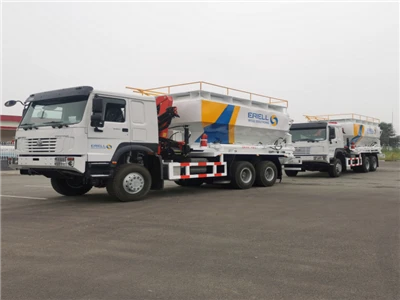
The manufacturing process of hybrid explosives transport vehicles (on-site mixed explosives vehicles) is not an isolated vehicle manufacturing process, but a highly collaborative industrial operation system integrating "ground semi-finished product preparation - safe transportation - precise on-site mixing - direct filling of blast holes". Its core lies in transferring the most risky "final synthesis" stage of explosives from a fixed factory to a controlled mobile platform, completing it on-site in real time, achieving a revolutionary combination of safety and efficiency.
I. Process Starting Point: Semi-finished Product Preparation and Storage at the Ground Station
The entire process begins at the supporting ground preparation station (fixed or mobile). Its main task is to process raw chemical raw materials into relatively safe semi-finished products and store them in categories. Taking the most common emulsion explosives as an example, key steps include:
1. Aqueous Phase Preparation: Dissolving oxidizers such as ammonium nitrate in water to form an ammonium nitrate aqueous solution of a certain concentration, and storing it in a dedicated insulated tank.
2. Oil Phase Preparation: Diesel fuel, emulsifier, wax, and other flammable agents are mixed evenly with a sensitizer under heating to form an oil phase solution, which is then stored in a separate insulated container.
3. Sensitizer Preparation: A solution of trace components such as a chemical foaming agent is prepared separately.
These semi-finished products (aqueous phase, oil phase, and sensitizer) do not possess detonator sensitivity under normal conditions and belong to the 1.4S category of extremely insensitive explosives, thus achieving intrinsic safety during storage and subsequent transportation.
II. Process Integration: Loading and Transportation of Semi-finished Products
Upon receiving a blasting assignment, the mixed-load vehicle enters the ground station. Using a dedicated pumping and metering system, the pre-prepared aqueous phase, oil phase, and sensitizer semi-finished products are pumped separately into their respective independent and isolated dedicated hoppers (tanks) on the vehicle. After loading, the vehicle is converted to transportation mode. At this point, it is transporting safe semi-finished raw materials, not finished explosives, fundamentally eliminating the significant risks associated with long-distance transportation of traditional finished explosives.
III. Core Components: On-site Mixing and Coupled Loading
Upon arrival at the blasting site, the process enters the core "mobile pharmaceutical manufacturing" stage:
1. Precise Metering and Mixing: The operator sets the formula and single-hole charge amount on the onboard computer control system. After startup, the system uses a high-precision metering pump (such as a rotary pump) and flow sensors to pump the aqueous and oil phases into a dynamic emulsifier or mixer in a preset ratio, instantly forming a latex matrix under high-speed shearing. Simultaneously, a trace amount of sensitizer is precisely injected.
2. Continuous Delivery and Loading: The uniformly mixed latex matrix (or ANNUF explosive mixture) immediately enters the delivery spiral or hose, and is continuously and directly pumped into the bottom of the borehole under hydraulic or pneumatic drive. The charge amount is automatically accumulated by the system for precise control.
3. Final Sensitization: For emulsion explosives, the latex matrix undergoes foaming sensitization within the borehole for a period of time (e.g., 10 minutes) before finally forming a finished explosive with detonator sensitivity. This means that the material remains in a safe state during mixing and loading.
IV. Closed-Loop Process: Data Recording and System Cleaning
After each operation, the control system records data such as total charge quantity and formula. During work breaks or at the end of each day, the water-air cleaning system must be activated to thoroughly clean the mixing system, pumps, valves, and delivery pipelines to prevent residual materials from solidifying and causing blockages or safety hazards.
In summary, the essence of this process lies in "divide and conquer" and "on-site synthesis." By breaking down hazardous processes into safe semi-finished product preparation and controlled on-site synthesis, and leveraging a highly automated vehicle-mounted system to achieve precise, continuous, and efficient coupled charging, it not only reconstructs safety boundaries but also significantly improves the economy and quality of blasting operations, representing the mainstream direction of modern engineering blasting technology development.