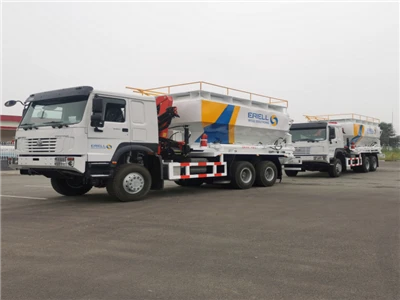
In the modern civilian explosives supply chain, hybrid explosives transport vehicles (on-site mixed loading vehicles) are not only a technological innovation but also a revolutionary practice of a systemic safety concept and management model. Their importance far exceeds the scope of a mere transportation tool; through technological innovation, they profoundly change the risk structure of the entire chain from production and distribution to use, possessing significant safety, economic, environmental, and social value.
A Fundamental Enhancement of Safety Value: A Paradigm Shift from "Transporting Explosives" to "Transporting Raw Materials"
Their core importance lies in fundamentally reconstructing safety boundaries. The traditional model transports highly sensitive finished explosives, where any accident during transport (such as traffic accidents or fires) could directly lead to a catastrophic explosion. The hybrid vehicle model overturns this process, transporting relatively insensitive semi-finished products such as latex matrices without detonator sensitivity. These materials are normally defined as 1.4S items (extremely insensitive explosives), and their transportation risk is orders of magnitude lower than that of finished explosives (1.1 items). This means that the highest-risk form of "explosive" exists only briefly at the blasting site and in the final stage of loading into the borehole, and is immediately used. This completely eliminates the inherent risks of the two most dangerous stages-long-distance transportation and transshipment storage of finished explosives-achieving both "spatial compression" and "time delay" of risk, a superior embodiment of the inherent safety concept.
Revolutionary Optimization of Operational Efficiency and Blasting Effects
It is not only a safety tool but also a highly efficient production tool. This technology integrates "pharmaceutical preparation" and "explosive loading," achieving precise, efficient, and integrated blasting operations. The onboard computer can adjust the distribution ratio of each group in real time and precisely according to the design requirements of different boreholes, producing the optimally matched explosives, which are then directly pumped into the borehole with high filling density and uninterrupted continuity. This greatly improves the operational efficiency of large-scale mine earthmoving and tunnel excavation, significantly reducing overall costs. Simultaneously, the "customized" explosives it provides allow for more refined blasting designs, improving blasting effects (such as block size control) and effectively reducing secondary hazards such as vibration and flyrock.
A Technological Hub for Closed-Loop Management of the Entire Chain
This vehicle model is a key technological pillar for the national implementation of "full life-cycle, traceable, and closed-loop management" of civilian explosives. The vehicle itself integrates intelligent terminals such as satellite positioning, video surveillance, electronic locking, and data recording. Its operational data (such as driving trajectory, pharmaceutical formula, charge quantity, and operation location) can be transmitted back to the monitoring platform in real time or periodically. This means that the flow, use, and status of every gram of material, from substrate production, vehicle transportation, on-site mixing to final injection into the blast hole, become completely transparent and traceable. This achieves an upgrade in the regulatory model from "managing warehouses" to "managing data flow," and from static approval to dynamic monitoring, building a strong technological barrier to prevent illegal loss, misappropriation, and misuse.
A Key Driver for Promoting Industrial Upgrading and Sustainable Development
The hybrid vehicle model has driven the optimization of the entire civilian explosives industry's industrial structure. It prompts production enterprises to transform from single product suppliers to "integrated blasting solution providers," increasing the industry's added value and technological content. Meanwhile, due to the high energy utilization rate and good blasting effect of on-site mixed explosives, it helps reduce drilling volume and improve resource recovery rate, meeting the requirements of green mining and sustainable development. Its application also forces process improvements in upstream production lines (ground preparation stations) and standardization and normalization of downstream blasting operations.
Conclusion: Therefore, the importance of mixed explosives transport vehicles lies in their ability to achieve a systematic reduction in safety risks, a fundamental leap in operational efficiency, a revolutionary enhancement of regulatory capabilities, and a strategic upgrade of the industrial model through the technical path of "raw material transportation, on-site preparation, and immediate use." It is not merely a vehicle, but a hub connecting a safe, efficient, and intelligent modern blasting operation system, representing the core direction of future development in the civilian explosives industry, and a model of deep integration of national governance modernization and industrial technological progress in this high-risk field.